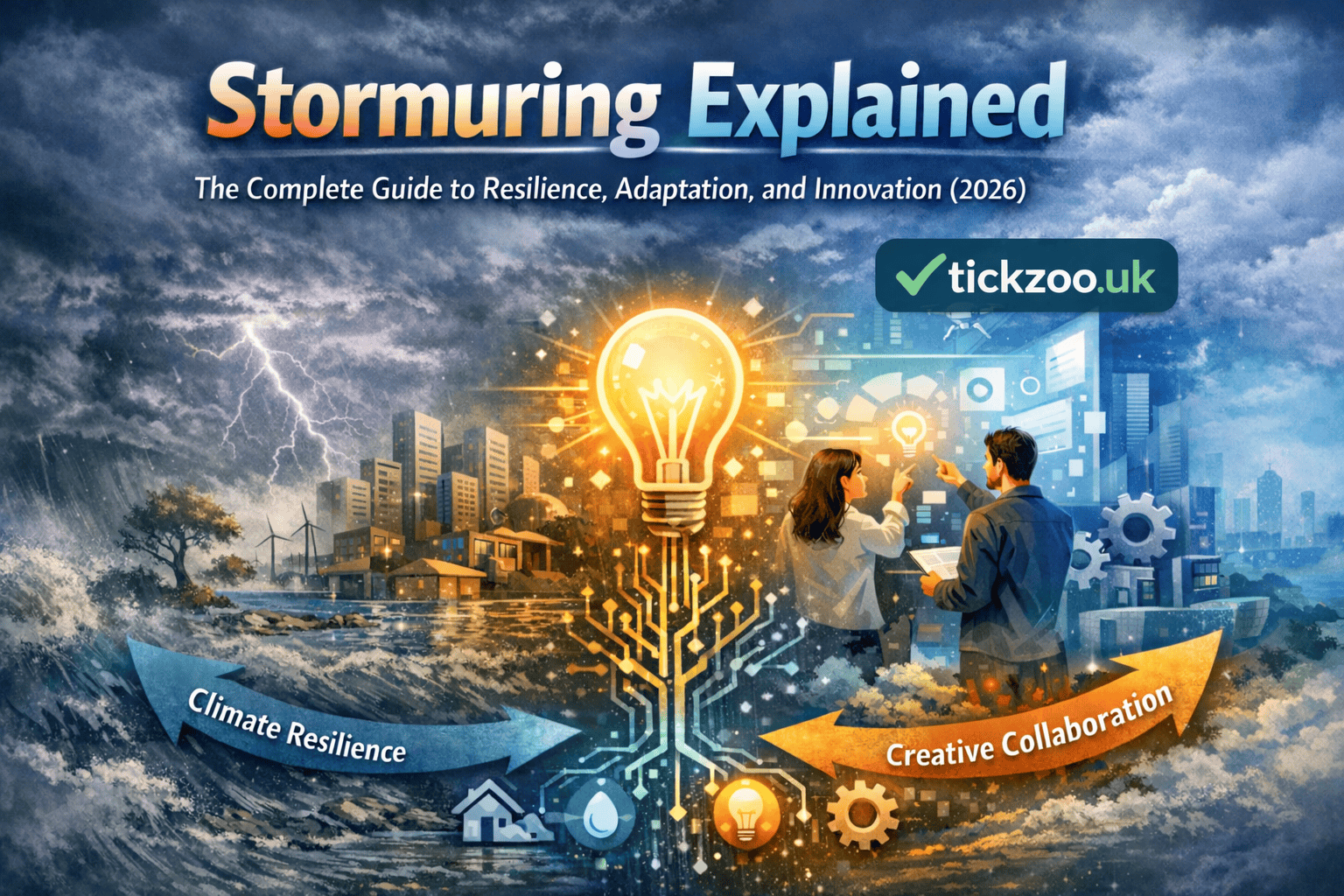
In an era defined by uncertainty — from relentless market disruption to climate instability — a new term is shaping how we think, act, and thrive: stormuring. This emerging concept spans two powerful realms: structured innovation and climate resilience. By uniting creativity with adaptability, stormuring offers a holistic framework for transforming disruption into opportunity.
In this comprehensive guide, we’ll explore every dimension of stormuring — from its origins and definitions to practical applications, psychological implications, and future potential. Whether you’re a business leader, climate planner, educator, or curious reader, this article reveals why stormuring is becoming central to navigating 21st-century complexity.
What Is Stormuring?
At its core, stormuring combines the imagery of “storm” (disruption, unpredictability) with structured adaptation — whether in creative problem-solving or community resilience. In business and innovation, it refers to a structured method of generating, evaluating, and implementing ideas that goes far beyond traditional brainstorming. In climate and environmental science, it describes enduring cycles of storms and extreme events that strain systems before full recovery can occur.
Unlike traditional resilience, which often focuses on “bouncing back,” stormuring highlights transformation amid disruption by turning chaos into structured progress.
The Origins and Evolution of the Term Stormuring
The word “stormuring” is a modern linguistic construct that doesn’t yet appear in academic dictionaries, but it’s gaining traction across digital discourse, strategy literature, and climate conversations. It blends metaphors of chaos and growth to describe a dynamic process whereby disruption becomes a catalyst for structured change.
Historically, similar concepts have been explored — from design thinking methods in innovation labs to resilience frameworks in climate science — but stormuring captures both creative and physical resilience in a single term. Its dual meaning reflects how modern challenges often straddle disciplines.
Stormuring in Climate Resilience and Environmental Adaptation
Storming in the environmental sense refers to compounding extreme weather events that don’t allow enough time for recovery before the next shock arrives. Instead of seeing storms as isolated crises, this perspective acknowledges that extreme weather is becoming more frequent, intense, and interconnected as the climate warms.
Why Stormuring Matters in Climate Context
- Climate change is driving more severe and frequent extremes — droughts, floods, cyclones — that overwhelm infrastructure and ecosystems.
- According to climate data, extreme weather event intensity and frequency have dramatically increased over recent years, outpacing historical averages.
- Globally, extreme weather has caused trillions in losses, with reports estimating more than $2 trillion in damage over the past decade.
Human, Economic, and Environmental Impact
Stormuring’s effects extend beyond infrastructure:
- Human cost: Increasing displacement, health risks, and mental stress due to repeated disaster exposure.
- Economic strain: Rising insurance costs, disrupted supply chains, and expensive rebuilding cycles.
- Ecosystem damage: Coral reefs, wetlands, and forests struggle to recover when shocks stack.
These pressures reveal that traditional disaster response models — reacting after each event — are no longer sufficient. Instead, planners now emphasize continuous adaptation, anticipatory design, and resilience built into systems themselves.
Storming as a Collaborative Innovation Method
In business and organizational settings, storming has emerged as a structured approach to problem-solving and innovation. Unlike typical brainstorming — which often prioritizes volume of ideas without direction — stormuring provides a framework that moves from ideation to execution.
Why Traditional Brainstorming Falls Short
Research shows that unstructured brainstorming can suffer from:
- Groupthink, where dominant voices overshadow diverse insights
- Lack of follow-through, with ideas left undeveloped and unimplemented
- Inefficient use of time and resources
- Brainstorming sessions often generate many ideas but few actionable outcomes.
The Six-Step Storming Framework
Stormuring adds structure and intent to creative sessions with a repeatable process:
- Define the problem clearly — specify measurable goals
- Generate ideas inclusively — ensure diverse voices are heard
- Evaluate ideas using criteria — select based on impact
- Prototype promising solutions — build real trials
- Test and iterate — refine based on feedback
- Implement and scale — turn validated ideas into reality
This ensures ideation leads to measurable results — whether lowering customer churn, increasing innovation output, or improving team collaboration.
Psychological and Cultural Dimensions of Stormuring
Stormuring touches more than organizational strategy — it influences how individuals and communities think about adversity, uncertainty, and growth.
Growth Through Repeated Disruption
Humans tend to seek stability, yet repeated disruption can force deeper psychological adaptation. Stormuring reframes these encounters not as setbacks but as opportunities for:
- Creative thinking and problem-solving
- Emotional growth and adaptability
- Community cohesion in adversity
This mirrors the concept of “post-traumatic growth,” where individuals report increased personal strength and appreciation for life after challenges.
Cultural Narratives of Resilience
Communities that embrace stormuring often embed elements of resilience into culture — through storytelling, rituals, and design traditions that reflect living with uncertainty.
Economic and Strategic Implications of Stormuring
Stormuring impacts strategic planning, risk management, and long-term decision-making across sectors.
From Reactive to Proactive Investment
Economic analysis shows that every dollar invested in resilience yields multiple dollars in return by avoiding disaster losses and enabling faster recovery.
Corporate Strategy and Adaptation
Companies adopting storming principles build:
- Stronger innovation pipelines
- Agile organizational structures
- Systems that withstand market volatility
Businesses are increasingly incorporating structured ideation into digital transformation, product design, and operations planning.
Real-World Applications of Stormuring
Stormuring is not theoretical — it’s practical and applied across contexts:
Climate & Urban Design
Examples include:
- Elevated homes and flood-resistant infrastructure
- Green spaces that absorb stormwater
- Early warning systems and community training
Bangladesh’s flood-adaptive strategies and Houston’s post-Harvey infrastructure redesign reflect stormuring in practice.
Business Innovation
Startups and enterprises apply stormuring to:
- Launch new products
- Solve operational bottlenecks
- Drive continuous improvement
Education systems integrate it into curricula to teach collaboration and design thinking.
Policy & Governance
Governments use resilience frameworks to shape zoning laws, infrastructure codes, and disaster funding — recognizing that repeated storms require long-term planning.
Why Stormuring Matters in 2026 and Beyond
Stormuring’s relevance continues to grow because:
- Climate volatility is intensifying
- Markets and technologies shift rapidly
- Organizations need structured adaptability
- Individuals face complexity in their personal and professional lives
Stormuring offers a mindset that sees disruption as a dialogue rather than a threat — a consistent theme in digital culture and strategy.
Common Misconceptions About Stormuring
Stormuring is not…
- Just a buzzword
- Merely resilience or survival
- Only about the weather
It is a philosophy of structured adaptation that applies across disciplines.
How to Practice Stormuring
To embrace stormuring:
- Define problems with clarity
- Involve diverse perspectives
- Use structured frameworks like prototyping and testing
- Learn iteratively
- Build feedback loops
These principles apply equally to business challenges and climate planning.
The Future of Stormuring: A Unified Framework for Adaptation and Innovation
Stormuring’s dual identity — as a method for innovation and a lens for resilience — makes it uniquely suited for future challenges:
- AI-enhanced stormuring could accelerate ideation and risk modeling.
- Climate-smart cities will integrate stormuring into infrastructure design.
- Education systems will teach storming as a core skill.
This reflects a broader shift towards adaptability, interdisciplinary thinking, and intentional transformation.
Frequently Asked Questions (FAQs)
What does stormuring’s mean?
Stormuring is a structured approach to deal with disruption in innovation and climate resilience by turning chaos into actionable progress.
Is stormuring’s a real word?
It’s an emerging term gaining usage in strategy, climate science, and digital culture.
How is stormuring different from resilience?
Resilience often implies recovery to a previous state, while storming emphasizes transformation and adaptation within disruption.
Can stormuring’s be applied outside of business and climate?
Yes — in personal growth, education, policy, and community planning.
Will technology play a role in stormuring’s future?
Absolutely — tools like AI can simulate scenarios, test solutions, and speed adaptation.
Conclusion
Stormuring represents a paradigm shift in how we approach disruption — whether in markets, communities, or the environment. It empowers us not just to withstand storms, but to harness them for growth, innovation, and lasting resilience.
In a world where uncertainty is the norm, stormuring isn’t just useful — it may be essential.